
The Red Garage House: Staging Pics
As a reminder, here are the BEFORE pictures of The Red Garage House…
And now here are the AFTER pictures of The Red Garage House:

Front of House
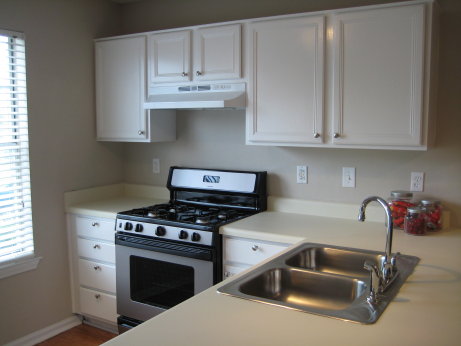
Kitchen
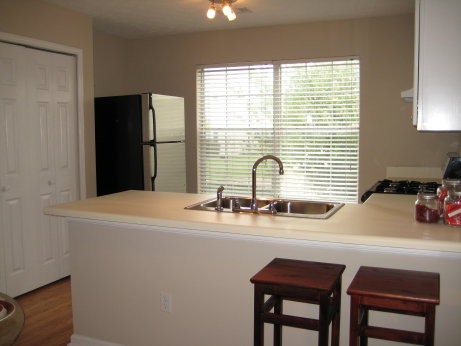
More Kitchen
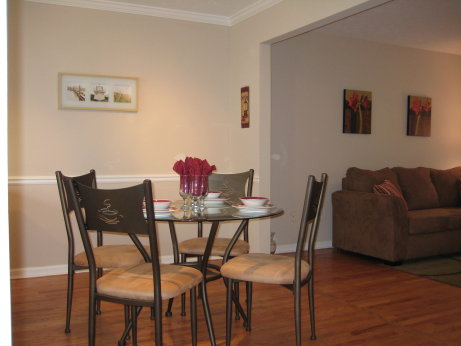
Dining Room

Living Room

More Living Room

More Living Room
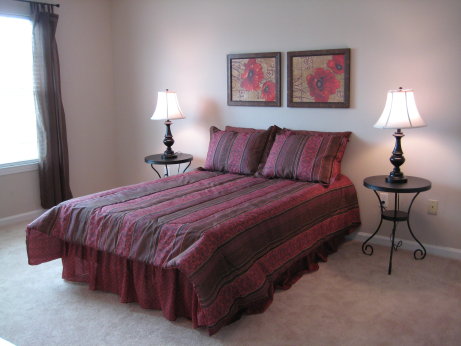
Master Bedroom

More Master Bedroom
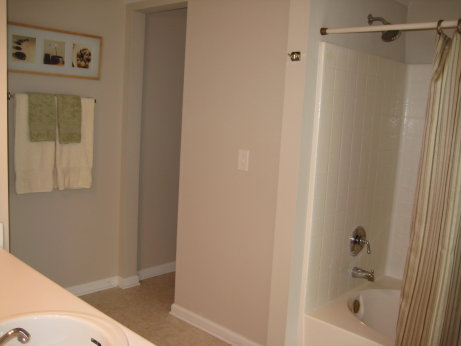
Master Bathroom

Second Bedroom

Hall Bathroom

Office or Third Bedroom

Covered Patio



First time on the site. Hope its not a repeat question. I notice that you stage the property with furniture and pictures. Can you touch on your philosophy vs leaving the house empty? Thanks
Hey Chris –
From what we’ve seen, staging makes a tremendous difference, especially in this market. Here are a few reasons:
– Many home buyers can’t visualize what a space will look like after it’s furnished, and if you can give them that perspective (by actually furnishing it), they’ll very likely perceive your property better than other properties that are vacant.
– Staging allows you to hide the flaws of a property. For example, in this property, the living room was pretty small (as was the dining area). But, because we were able to find furniture that was also small, it made the rooms seem MUCH bigger. In fact, when we closed on this property yesterday, the buyer (and the agent) both said that the staging was key to their putting in an offer. In fact, they kept much of the furniture as part of the deeal.
– Staging allows you to accentuate the good things. For example, in this property, there was an outside covered porch. The space was great, but it wasn’t clear what someone could do with it. So, we put a couple chairs, a table and some flowers out there to make it clear how cozy this outside area could be to a buyer.
From what I’ve seen, staging a house won’t necessarily get you a higher offer (though it might)…more likely, it will get you a MUCH quicker sale. And in this market, that’s very important.
We generally get a lot of feedback from agents and buyers about our staging, and it’s always tremendously positive. My wife is planning to start a staging business specifically for investors…
i’ve noticed your formula for calculating the price you offer for a flip, another investor suggested i used the 70% rule, arv x.07-renovation cost= mpp. what your philosophy on this formula vs yours. what should my ideal profit be.
Kareem –
Every investor has a different formula. The formula you mentioned (70% of ARV) is okay, but depending on the ARV, it may not leave you much profit. The goal of that formula is to factor all of your holding costs and fees into that 70%, along with your profit. If the ARV of a property is $100K, and you use the 70% formula, then you have $30K for your costs and your profit. If your costs are $15K (as mine would be), that leave $15K for profit.
But, what if the ARV is less than $100K? Your costs are probably still about the same, so that means your profit will decrease. And for high-end houses, you probably can’t buy the house for 70% of ARV, as that would be an extremely low price.
The thing I like about my formula is that it’s not price sensitive…I will be able to determine MPP for my exact profit amount every time, as opposed to the profit being dependent on the ARV and the fixed costs.
As for what your ideal profit should be, that’s a personal decision. I like to be reasonably confident I’ll make $20K per project…but some are happy with less or need more…
thanks for the quick response. im going to be working with a general contractor on my project mr. scott and i was wondering is it my responsibility to pick out everything for the project like cabinets, countertops,tile ,appliances etc. or should i leave it up to the GC.
Kareem –
I’ll write up a blog post in the next few days to address that issue, but suffice it to say that there is a lot of disagreement among investors on whether you should be purchasing your own materials or not.
Here are some thoughts from various people: http://www.biggerpockets.com/forums/67/topics/40366-always-purchase-your-materials-yourself-or-else-
Personally, I buy all the finishing materials for the jobs (light fixtures, plumbing fixtures, appliances, carpet, sinks, etc), but allow the contractors to provide all the building materials (lumber, siding, roofing material, plywood, etc).
As for windows and cabinets (two other big material costs), I order them through the same company that installs them – a window company and a cabinet company.
Hello Mr. Scott,
Great website!! This is absolutely awesome!! Quick question…What made you and your wife to target homes AVR in the 100k-150k range??? Just trying to get an idea of whats the best best range of homes to get started in??
Hey Marlin,
When we started buying, and in the area where we decided to buy, this was the most common price point for the largest percentage of buyers. If there had been more buyers at the $300K price point (or the $50K price point), we would have been buying in those price points instead. For us, it’s all about the number — where the largest percentage of potential buyers is, that’s where we want to be!
I used to be a real estate agent. It’s amazing that staging isn’t taken seriously, nor the value of good photos.